


A good internal communication calendar makes sure employees get the right information at the right moment throughout the year, without drowning in scattered updates. In this article you will learn how to build your communication calendar for 2027: from goals and yearly themes to a rhythm you can keep up, with inspiration for every month.
What is an internal communication calendar?
An internal communication calendar is the yearly plan for your internal communication: which themes, campaigns and messages you publish when, through which channel and for which audience.
So it is more than a list of “what we post when”. A good calendar brings calm and clarity: for you, for your communication team and for everyone in the organisation. That is why you don’t start with content, but with a clear plan: what do you want to achieve in 2027, and which themes truly deserve attention?
Why do you need a communication calendar?
Because without a plan you send more messages than employees can process, and because organisations with clear goals get more out of their internal communication.
According to the 2026 internal communication benchmark by vonk, information overload is the biggest barrier to reach (58%), followed by employees’ lack of time (56%). A calendar helps you spread messages out and stops departments from competing for attention at the same moment.
The same benchmark shows that 59% of organisations work without set goals. Organisations that do have goals are more often satisfied with their reach (32% versus 22%). A calendar built on goals is not paperwork, it is the foundation of communication that lands.
How do you create a communication calendar?
Start with your goals, choose two to four yearly themes, work in short campaigns, publish in three waves and pick a rhythm you can sustain. Review briefly after every campaign.
Start with your goals
Before you schedule a single post, the most important question is: what do you want to change or improve for employees in 2027? Without that starting point, a calendar quickly turns into a random list of posts that may say something, but don’t move anything forward.
Think of goals such as getting people on board with a new way of working, reducing recurring questions, supporting employees better in hybrid collaboration or strengthening a culture theme. Once those goals are clear, making choices becomes easier. You are no longer planning just to plan, you are planning because you are working towards something.
Choose two to four yearly themes
Only then do you choose your big themes for the year. Keep it simple: two to four strong anchors is usually enough, such as safety, wellbeing, innovation or strategy. With a limited number of themes you build recognition. Employees quickly feel: “ah yes, this fits that story we already know.” And you don’t have to start from scratch every month, because you can repeat, deepen and reuse content.
In short: goals give direction, themes give structure. Together they form the foundation of a calendar that isn’t just filled, but truly works.
Work with short, recognisable campaigns
A theme only comes alive when you pick it up for a while and make it recognisable. That is why campaigns work best: short periods with one clear focus.
- You create one central intranet page or main article. That is your base.
- Around it you make short variants: a summary for Teams or Outlook, a short video, a visual.
- Everything points back to that one core page.
Result: one story, multiple entry points, no fragmentation.
Publish in three waves
Not all employees read at the same moment. So repeat your message smartly, without copy-pasting:
- Announcement: share what is coming and why it matters to colleagues.
- Launch: add context, proof (a case, quote or screenshot) and one clear action.
- Follow-up: bundle questions, share results and explain what comes next.
That way everyone gets the message, including those who log in later.
Write for your reader’s task
Employees don’t want long texts. They want to know: what do I need to do, why is this relevant to me and where do I click? So keep your core message as simple as possible:
- a clear title;
- one sentence with the essence;
- one concrete action at the end.
Only use examples if they make that action clearer.
Choose one source and multiple doors
Make your intranet the place where the full information lives. Use Teams, Outlook and the mobile app mainly to bring people there. Content can be shorter or more visual on those channels. One source means less confusion. You can read how to make your channels work together in our article on an omnichannel strategy for internal communication.
Don’t forget employees without a computer. At Plopsa, with nearly 5,000 employees of whom most work in the parks, news posts and push notifications through the mobile app are now the most used channel.

Plan a rhythm you can sustain
You don’t need to start a new theme every week. A simple rhythm works best, for example one main theme per month:
- Week 1: teaser or announcement
- Week 2: main content goes live
- Week 3: activation with a how-to, Q&A or short reminder
- Week 4: answers to questions and a look ahead
Always leave room for real urgencies. When Plopsa received a limited number of tickets for the final K3 show at very short notice, there was no time for a visual or an email. An intranet post, a push notification and two reminders were enough: within a few days, almost every ticket had been claimed.
Review briefly after every campaign
After each campaign, take a short moment: what worked, what do you drop, what do you repeat? The best-performing pieces become evergreen and come back later in your planning. That way you build on what works instead of starting over. You can read how to measure this in our article on measuring the effectiveness of internal communication.
Which themes can you plan per month in 2027?
Link every month to one recognisable theme with one clear action for employees. Use this list as inspiration and adapt it to your own yearly themes.
- January: a New Year update with a clear outlook: what does this mean for you?
- February: make appreciation visible with a compliments campaign or team spotlights.
- March: learning and growth, with tips from colleagues.
- April: make privacy and security tangible with familiar scenarios.
- May: wellbeing in practice: small habits and a low-threshold Q&A session.
- June: sustainability from paper to practice, with one action everyone can take.
- July: smart handovers during the holiday period with a clear handover guide.
- August: “what you missed”, a quick guide with the most important links.
- September: refresh processes: the most frequently asked questions answered step by step.
- October: cyber awareness without finger-wagging: let colleagues discover for themselves.
- November: a short feedback survey that genuinely feeds into next year’s planning.
- December: results, thanks and a clear-eyed look ahead.
Tip: tie every idea to one clear next step. Without action, it is just information.
How do you manage your communication calendar in your intranet?
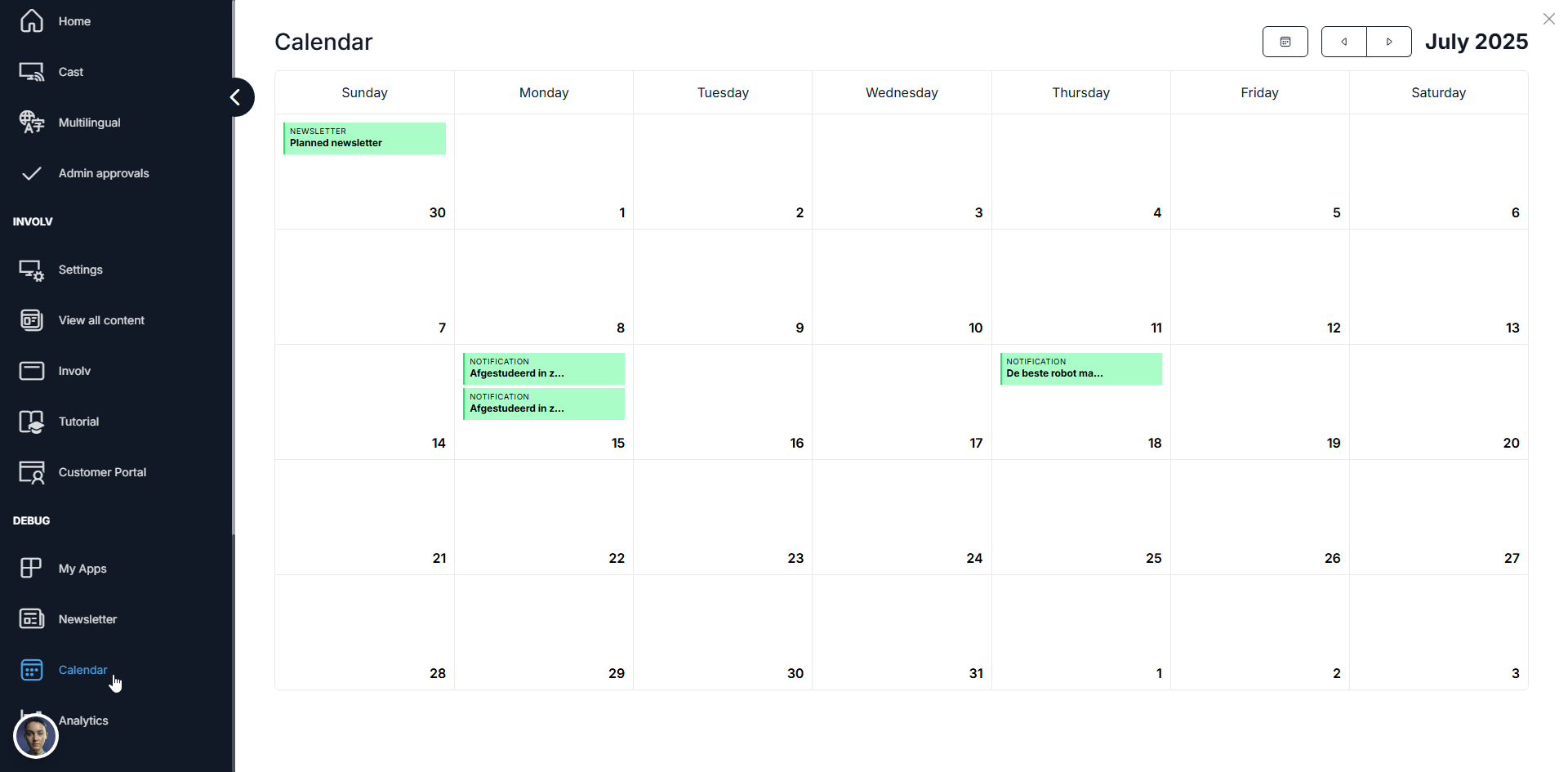
By keeping your planning and your publications in the same place. With the Content Calendar in Involv, you manage themes, owners and publication dates directly in your intranet.
You can also add placeholders: a planned newsletter or a post that still needs to be written is already on the right day in the calendar. That way everyone sees what is coming, even when the content isn’t ready yet.
No more separate Excel file that is out of date after two months. You publish news through a fixed process with a quality check on tone, accessibility and links. That gives your calendar a recognisable cadence colleagues can trust.
Involv also helps make sure your calendar actually lands:
- Targeting by audience and location: every message reaches the people it concerns, so you don’t add to the overload.
- Push notifications and the mobile app: employees without a computer get your campaigns too.
- Involv Insights: more data on your intranet content than standard SharePoint analytics, so after every campaign you know what worked.
Read more about how communication teams work with Involv on the Involv for internal communication page.
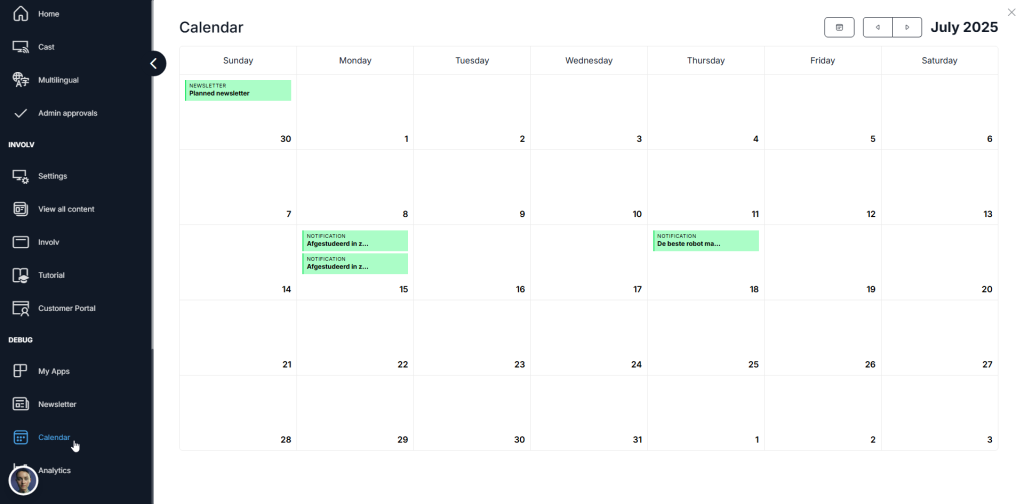
The Content Calendar in Involv. Click the image to enlarge it.
Conclusion: less noise, more results
A good communication calendar doesn’t predict the future, it gives direction. By planning from goals, working in short campaigns and publishing deliberately, you get less noise and more results. Exactly what you want to feel in 2027.
Plan and publish in one place
In a short demo, we show you how to manage your communication calendar in Involv, target messages to the right audiences and see what worked after every campaign.
Frequently asked questions about the communication calendar
What is an internal communication calendar?
An internal communication calendar is the yearly plan for your internal communication. It sets out which themes, campaigns and messages you publish when, through which channel and for which audience. That way employees get the right information at the right moment, without overload.
What is the difference between a communication plan and a communication calendar?
A communication plan describes why and what you communicate: your goals, audiences, messages and channels. The communication calendar turns that plan into when: which campaign or message appears in which week or month.
How many themes should a communication calendar have?
Two to four yearly themes are usually enough, such as safety, wellbeing, innovation or strategy. Per month, it works best to focus on one main theme. That builds recognition and lets you reuse content instead of starting from scratch every month.
What does a monthly rhythm for internal communication look like?
A simple rhythm is one main theme per month: an announcement in week 1, the main content in week 2, an activation such as a how-to or reminder in week 3, and answers to questions plus a look ahead in week 4. Always leave room for urgent messages.
Why should a communication calendar start from goals?
Goals determine which themes and messages truly deserve attention. According to the 2026 internal communication benchmark by vonk, organisations with set goals are more often satisfied with their reach (32%) than organisations without them (22%).
Which tool should you use to manage a communication calendar?
Many teams start in Excel or a planner, but that quickly drifts away from what is actually published. It is easier to keep the calendar in your intranet itself. In Involv, you manage themes, owners and publication dates in the Content Calendar, in the same place where you publish. With placeholders, you add planned posts to the calendar before the content is ready.
Sources
- Dorst, S. & Naudts, J. (Starfish Consultancy) (October 2026). Hoe goed bereikt interne communicatie de medewerker écht? Benchmarkrapport interne communicatie (How well does internal communication really reach employees? Internal communication benchmark report). vonk, network for internal communication, with the support of KBC.
- Involv (2026). Case study: Plopsa.