

Introduction
Employees decide in less than 30 seconds whether a message is relevant to them. How do you make sure your communication clears that bar?
Does this sound familiar? You have communicated a message twenty times across multiple channels, and a colleague still looks at you blankly: “Oh, I didn’t know.” That frustration is as old as internal communication itself – but the solution is not more channels or more repetition. The solution is targeting.
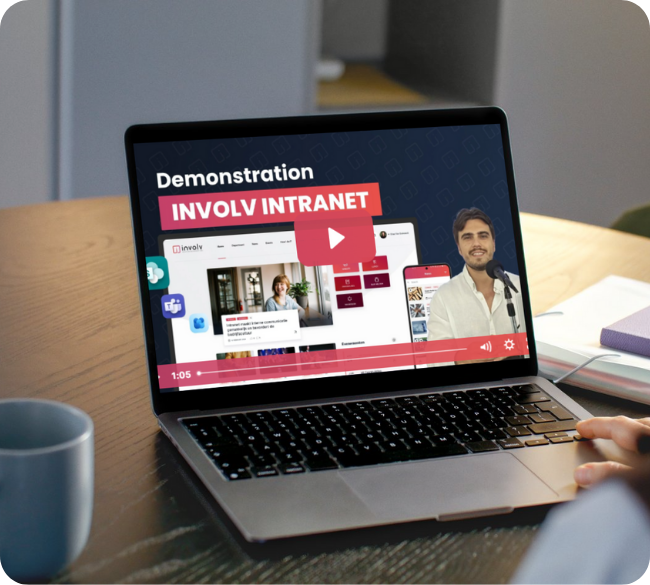
Communication expert Evelyne Sinnaeve, with nearly thirty years of experience in employee communication at major international companies and agencies, shared her views on information overload and targeted communication during a webinar (in Dutch) with Lien Van Roy (consultant at Involv Intranet). Her key message: stop broadcasting, start connecting.
Information overload is not a mistake – it is a symptom
Information overload occurs when you send more information than people can process, prioritize, and apply in their work. And that is almost universally the norm today.
But the real cause? Too many channels without a strategy. Email, Teams, WhatsApp, Slack, newsletters, intranet, posters, workshops… organizations stack communication channels hoping to reach everyone. The result is the opposite: people tune out.
“Less is more” sounds obvious, but in practice few organizations dare to let go of channels. The key is not cutting everything, but making clear agreements: which channel do you use for what, and for which audience? Without that structure, even the strongest message ends up with the wrong people or nowhere at all.
A telling example from real life: a company using Teams, Slack, and WhatsApp simultaneously. An employee posted an urgent update in Slack, convinced everyone would see it. Another team worked exclusively through WhatsApp and heard nothing. That reflex of thinking “I sent it, so they know” is one of the most persistent traps in internal communication.
The new mantra: target, target, target
If you take one thing away from this article, let it be this: targeted communication is not a luxury, it is the standard.
Employees decide in less than 30 seconds whether a message is relevant to them. Receive three irrelevant notifications? They tune out permanently. That means your next message – even if it is critical – is already lost before it is opened.
Targeting is more than a technical setting on your intranet. It is a mindset shift: from “I’ll send this to everyone because it can’t hurt” to “who is this actually meant for, and what do I want them to do with it?”
It also means making the expectation explicit. What should the recipient do with this message? Read and forget? Take action? Discuss with the team? Communication without a clear call to action is noise.
Prioritization: stop cannibalizing each other
One of the most familiar scenarios: every department communicates from its own sense of urgency. Safety has a campaign. HR is launching a new procedure. The CEO has a strategic update. Sustainability wants attention. And everyone is convinced their message is the most important.
The result? Messages cannibalize each other. A notice about the broken coffee machine drowns out the results of the satisfaction survey. Employees miss what matters. And as the communication manager, you spin your wheels without making progress.
The solution is an editorial meeting or content planning session: a regular moment where you review with all relevant stakeholders what is on the agenda for the coming months, how to prioritize it, and who gets space. The Province of Flanders does this well: they organize peer meetings with representatives from diverse target groups to literally check whether communication lands, is read, and is understood.
From internal communication to employee communication
A subtle but powerful distinction: Evelyne deliberately speaks about employee communication rather than internal communication. That word choice shifts the focus from the process to the person behind the recipient.
Employee communication covers everything an employee needs to do their job well – from the CEO announcement to the information exchanged at a shift handover in production. Everything is communication. And behind every recipient is a person with their own reality.
A nurse has a different workday than a policy officer. Someone in production does not sit behind a computer and cannot be pinged continuously. Someone at the front desk of a sports center experiences communication in a fundamentally different way than an office worker. Understanding that reality – and tailoring your communication accordingly – is the difference between noise and relevance.
Do I feel good at work? Evelyne’s 9 pillars
Based on more than 150 focus groups at small and large companies, Evelyne developed her own philosophy around “feeling good at work.” She identifies 9 pillars, including: feeling welcome, being supported, feeling involved, being treated fairly, feeling understood, being challenged, safety (both physical and psychological), and trust.
What does this have to do with internal communication? Everything. As a communication professional, you directly influence a large number of these pillars: the way you ask questions, how you express appreciation, whether you give people a platform, whether you make room for creativity and innovation. Internal communication is not just a relay channel – it is an instrument for building culture.
The human side: stop going corporate once you step inside
A striking observation: externally, companies go to great lengths to come across as human. Employer branding is full of real stories, faces, color, and energy. But the moment that same message goes internal, it suddenly becomes dry, formal, and corporate.
That gap is unnecessary. Your employer does not change when someone joins the organization. That relationship – human, warm, authentic – should carry through into your internal communication.
That also means: give employees the spotlight themselves. Not the director reading a policy message from behind a podium, but the project team members telling in their own words what they did and what they are proud of. Research shows that messages delivered by people themselves are read more, shared more, and generate more pride. The director can always support that content as a sponsor – but the spotlight belongs to the people.
Micro-experiences: the moments that stick
We remember little of what we read. Somewhat more of what we hear. But we remember remarkably well how we felt.
That is what makes micro-experiences so powerful. Map your employee journey – from onboarding to reintegration after illness, from the first day to an internal promotion – and identify the moments where a small, human intervention makes all the difference. A bunch of flowers when someone is going through a hard time. A moment in the spotlight for someone who brought a project to a successful close. An honest, warm message on day one that “I don’t know” is completely okay.
Those happy moments cost little, but go deep. They make employees feel heard, seen, and valued – and that is exactly what communication looks like at its best.
Getting started in practice: begin with governance
Does all of this sound overwhelming, especially if you are running the communications function on your own? Good news: you do not need to change everything at once.
Start with a simple governance framework: a document that defines, per communication profile, who communicates, to whom, with what goal, in which language, via which channel, and how follow-up is handled. Including the element of appreciation – because that almost always gets dropped.
It may seem like extra work, but it saves you an enormous amount in the long run. It gives structure to everyone who communicates in the organization, prevents chaos, and ensures that you as a communication specialist play a strategic role instead of constantly putting out fires.
And perhaps the most important tip of all: stop expecting things you have never said out loud. That managers “just know.” That teams will naturally strike the right tone. Make it explicit. Write it down. Then you do not have to repeat it every single time.
Checklist: 5 steps toward more relevant internal communication
- Define your single source of truth: Which channel or platform is the central entry point for employees? Make sure everyone knows it and that your communication starts there.
- Target deliberately: With every message, ask yourself: who is this really for? Do not send to everyone if it is only relevant to some.
- Plan content like an editorial team: Hold regular content meetings with stakeholders to prioritize, plan, and align messages.
- Put yourself in your recipients’ reality: Who are your target groups? What is their workday like? Which channels do they use? Build from there, not from your own workflow.
- Build your governance framework: Define who communicates what, when, to whom, via which channel, and how you show appreciation. And stick to it.
Want to watch the webinar? You can do so here (in Dutch).
Want to explore how an intranet as a central communication platform can help you reach your employees in a more targeted and relevant way? Get in touch with us – we are happy to think along with you.