

“Take care of your employees, and they will take care of your business.” That well-known quote by Richard Branson is still relevant, but today it’s more than a nice saying. In a labor market with hybrid teams, information overload and rising expectations around wellbeing and development, a strong employee experience is directly linked to productivity, retention and engagement.
Several studies have shown a connection between investing in employee experience and higher stock prices and revenue.
More and more organizations are aware of its major impact on business growth and are now focusing on improving employee experience. According to Microsoft, “companies today spend more than $300 billion per year on employee experience. This figure includes employee development and training, benefits and wellbeing, and a wide range of technologies related to employee experience.”
But what exactly is an employee experience platform (EXP)? What does such a platform actually do for employees? And what should you pay attention to when choosing one?
What is an employee experience platform?
An employee experience platform is an integrated digital platform that supports employees throughout their entire workday. It brings communication, knowledge, tools, processes and social connection together – ideally in the “flow of work” (e.g., Microsoft 365/Teams).
The goal of an employee experience platform is to help employees feel more connected and supported, so they can perform at their best.
Why employee experience is such a priority right now
Employee experience isn’t a “nice extra”; it’s a requirement for organizations that want to keep performing. Three trends make this especially clear:
-
Hybrid and distributed work is here to stay. Teams no longer work in one place, so culture also needs to be supported digitally.
-
Engagement remains low worldwide. Gallup has shown for years that a large share of employees aren’t truly engaged, with a clear impact on performance and turnover.
-
Employees are drowning in tools and information. Many companies do have knowledge and systems, but they’re scattered. That wastes time and leaves people without context.
An employee experience platform is designed specifically to solve that fragmentation.
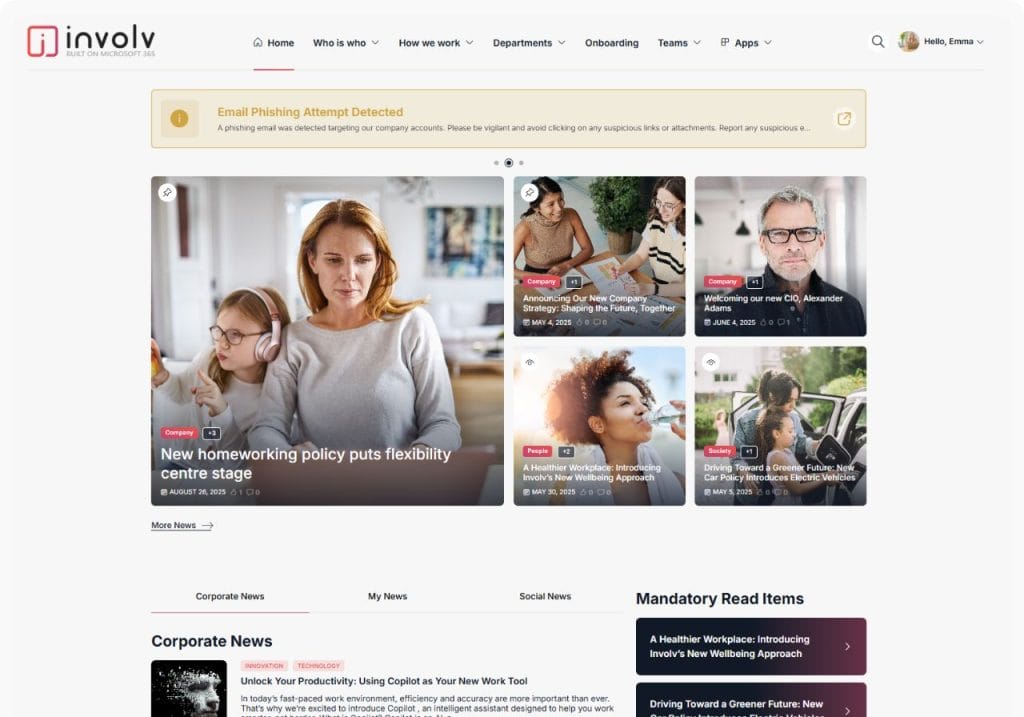
How an employee experience platform strengthens employees and the organization
1. Keep everyone engaged and informed
Internal communication often fails not because there’s “too little communication,” but because it’s too scattered. Employees miss news, context and priorities. According to a Gallup report, 74% of employees feel they don’t receive company information and news.
An EXP centralizes communication: news, updates, guidelines, videos, events, crisis messages… everything in one place. With smart targeting and personalization, each employee only sees what’s relevant to their role, location or interests.
Result: less noise, more trust, higher engagement.
Free whitepaper
Plan your intranet project
Planning a new intranet project? Download our free whitepaper and discover the steps needed to build an effective intranet.
2. Connect people with each other (even remotely)
Hybrid work makes collaboration more efficient, but it’s harder to maintain a sense of connection. People know each other less well, new colleagues settle in more slowly and knowledge stays in silos.
An EXP helps by adding social and “people discovery” features, such as:
-
a people directory
-
org charts and teams
-
rich profiles (expertise, projects, interests)
-
attention for birthdays, new colleagues, milestones
This makes digital collaboration feel human again.
3. Provide fast access to information and tools
Every employee searches daily for documents, procedures, contacts, forms, projects, applications… When these are spread across SharePoint sites, Teams channels, mailboxes, network drives and separate SaaS tools, it costs a huge amount of time.
An EXP offers:
-
one central search experience across all sources
-
quick links to frequently used apps
-
a personal start page (“My workday”) with tasks, recent documents, news, agenda, etc.
Result: less time searching, less frustration, more focus on real value.
4. Strengthen culture, feedback and growth
A strong culture needs visible leadership and room for dialogue. Employee experience platforms support this through:
-
communication of mission, values and strategy
-
social interaction (likes, comments, tagging)
-
surveys, polls and feedback loops
-
ideation tools or improvement programs
-
integration with learning and development
This creates two-way communication and real engagement, not just top-down updates.
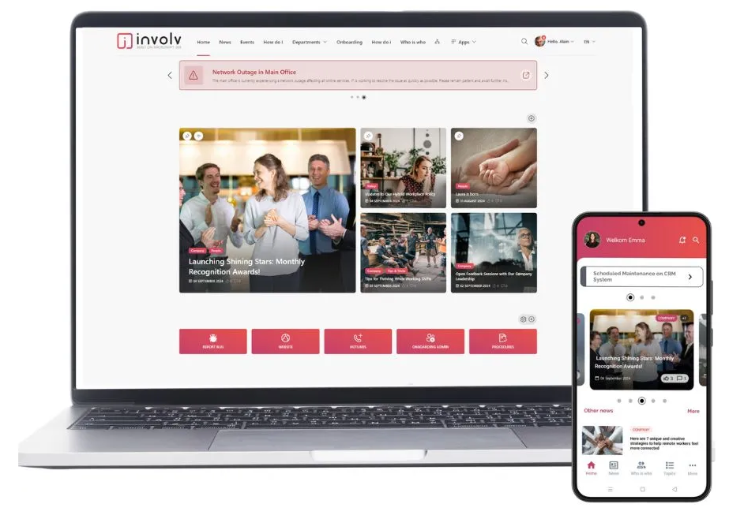
Employee Experience Platform vs. intranet vs. DEX: how does that work?
This is a common question, and the answer is pretty simple:
-
Classic intranet: mainly a central place for news and information.
-
DEX (Digital Employee Experience): focuses on the quality of digital tools and measuring/improving that experience (performance, adoption, friction).
-
EXP (Employee Experience Platform): broader than both; it combines communication, knowledge, collaboration, culture and growth in one ecosystem.
In practice, many modern intranets (like Involv) are employee experience platforms, because they cover that full scope.
Getting started with an employee experience platform in your organization
An employee experience platform is one of the fastest ways to improve internal communication, connection, culture and productivity at the same time – especially in organizations with many teams, locations or hybrid ways of working.
At Involv, we build employee experience intranets on SharePoint/Microsoft 365 that:
-
centralize and personalize communication
-
connect colleagues with each other
-
make information and tools accessible in one click
-
simplify and improve the digital workday
Want to see what that could look like for your organization? Feel free to book a demo or a chat – we’re happy to think along with your situation.